Two camps, and why each is half right
Workshops split into two schools. Cenauslug.pl recommends late May through the end of August. Maziak.szczecin.pl and just-fun-in-car.pl say October and early November. The only point of agreement: December, January and February are a mistake, because in those months you cannot dry out the hidden corners, and any product laid over moisture seals it underneath.
The date is set by the technical data sheet, not the calendar. ARMOR goes on at a substrate and ambient temperature of +10 to +30 degrees C, at relative humidity below 80 percent, on a dry surface. It is touch dry after 1-2 hours and reaches full resistance after 5-7 days. Those 5-7 days are the whole answer to the timing question. If the car is to meet road salt with a fully cured coating, the last sensible moment is the one where you still have a week of dry weather before the first salting run. In most of the country that means September and the first half of October, not late November.
The summer camp is right that in July any driveway meets the data sheet conditions, heated garage or not. The autumn camp is right that in summer the underbody is caked in dust and it is hardest to judge where corrosion actually begins. A compromise that works: wash and inspect in July, do the job in September.

Hard limits, no discussion
Below +10 degrees, do not start. The manufacturer gives no curing parameters outside the +10 to +30 range, so working in the cold means losing the one number you can lean on. Above 80 percent humidity, the same. Morning fog in October means air close to saturation, so a November job in the open usually breaks the data sheet conditions even if the thermometer reads 12 degrees.
Moisture in hidden corners is a separate problem. After a pressure wash, water sits in flanges, behind wheel arches and around spot welds for many hours. You wash one day and coat the next, after a night indoors in the dry or after a thorough blow-out with compressed air. If a fine mist comes out of a seam when you blow it, the substrate is not dry.
Five product types and what each is really for
The underbody chemistry market is inconsistent, including on durability claims: for wax you will find both a one-year claim and 3-5 years, from different sellers of the same product type. So treat durability as something to check with your own eyes once a year, not as a promise.
| Type | What for | Retail price |
|---|---|---|
| Bitumen compound | Flat floor areas, cheap and thick. Hard to remove, and you cannot see what is happening underneath | PLN 44.50/l |
| Clear wax | A thin layer over already protected or factory-sound surfaces, refreshed annually | PLN 59.99/l |
| Penetrating cavity fluid | Closed sections only, delivered with a probe | from about PLN 20/l in a 5 l pack |
| Rust neutraliser | Spot use, before you apply anything else | about PLN 100/l |
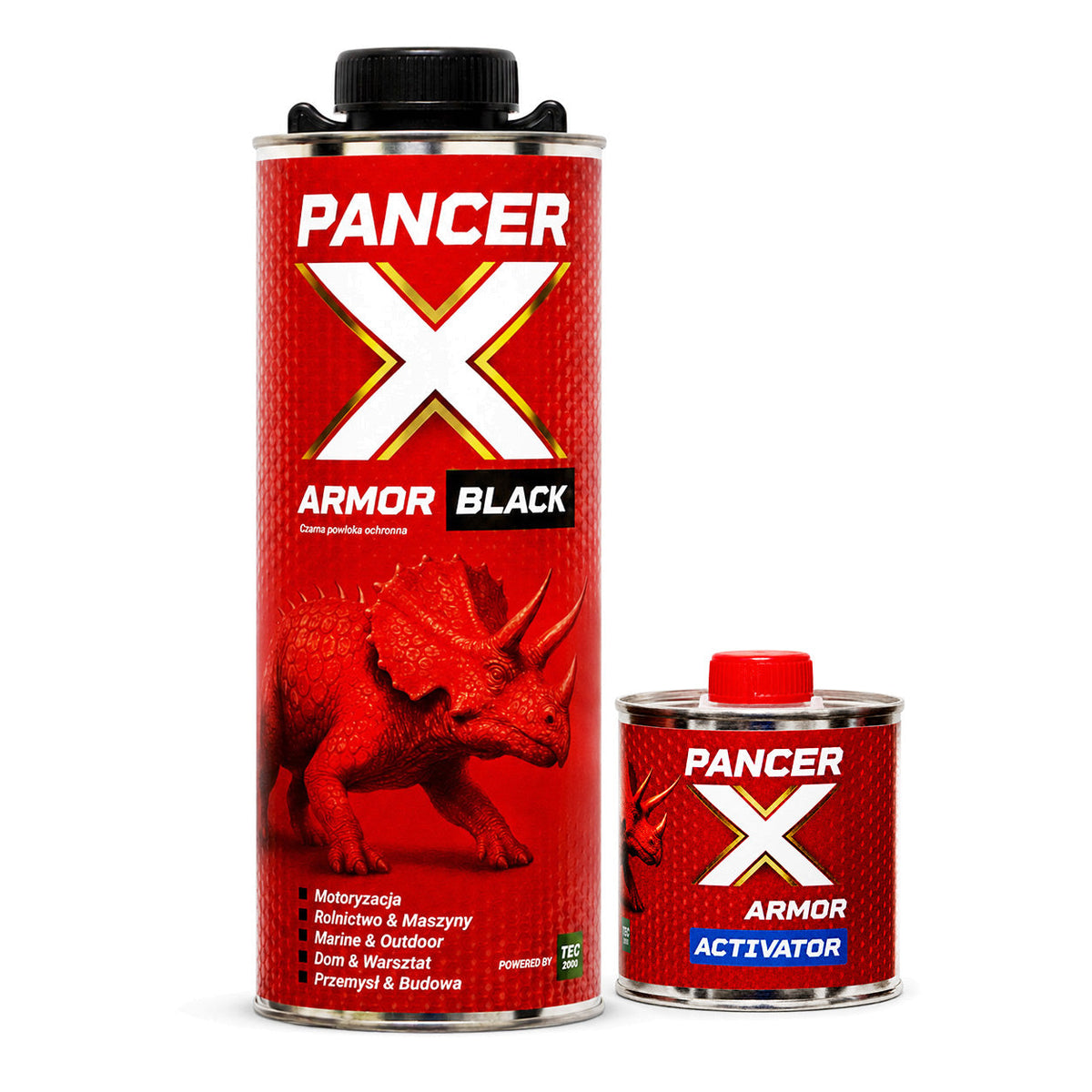
| 2K coating (ARMOR) | Exposed surfaces taking stone hits: wheel arches, sills, floor, pickup beds | PLN 139 per kit |
The price-per-litre column misleads if you read it without coverage. A litre of bitumen compound at PLN 44.50 spreads nothing like a litre of two-component coating, and what decides how much of each to buy is square metres, not litres.
Where a 2K coating makes sense
The ARMOR data sheet lists, among automotive uses, underbodies, wheel arches, sills, pickup beds, boot interiors and shields. These are places where the problem is a stone flying up from under a wheel, not capillary water sitting still. The coating is free of asphalts and bitumens, so it can later be covered with acrylic paint and matched to the body colour, which you cannot do with bitumen compound. It also has sound-deadening properties, audible around the wheel arches after the first drive on gravel.
Closed sections are a separate job and a separate product
This stage drops out of most quotes and out of nearly every guide. Sills, chassis rails, pillars and beams are closed sections. Corrosion starts inside them, because salty water gets in through the manufacturing holes and has no way to dry. A coating applied from the outside has nothing to do with it. ARMOR does not go into a section and is not meant to, because the inside of a section needs a penetrating fluid, liquid, delivered by a probe with a spray tip through the existing holes.
The reason fluid works where ARMOR does not comes down to how each one moves. A cavity wax is thin enough to travel by capillary action alone, so once it touches bare metal inside a sill it keeps creeping along seams, spot welds and lap joints for hours, into folds an outside coating could never reach. It also never dries hard. Where a cured 2K coating like ARMOR sets into a fixed barrier that keeps oxygen and water off the steel, a wax stays soft for the life of the car, so when the body flexes over a pothole and a hairline crack opens in the film around it, the wax nearby flows back and closes the gap on its own. Sellers describe the mechanism as displacing moisture off the metal before sealing it under the film. A barrier coating works differently: it keeps oxygen off the steel from the start. Whether that counts as self-healing or just capillary action doing its job depends on who is writing the copy.
Installers who work with lanolin-based cavity waxes push jobs into warmer weather for a related reason: heat lowers the wax's viscosity and lets it creep further into a closed sill before it stops moving. Same logic, different reason.
So when buying the service, ask not "what will you coat the underbody with" but "does the price include treating the closed sections with a probe, and through which holes". The surcharge for sills and wheel arches in workshop price lists is PLN 300-500. If the shop cannot point out the holes it feeds the fluid through, that stage is not in the offer.
How much material goes on
This is the biggest hole online, because nobody publishes the numbers, and a person standing in a shop has to decide how many cans to take. Coverage depends on the spray texture, and it depends on it strongly.
| Texture | Nozzle and thinning | Dry film | Coverage |
|---|---|---|---|
| Coarse | UBS 4 mm, 0 percent thinner | 200-250 µm | 2-2.5 m²/l |
| Medium | 2.5 mm, 5 percent | 100-120 µm | 4.5 m²/l |
| Fine | 1.8 mm, 30 percent | 60-70 µm | 6 m²/l |
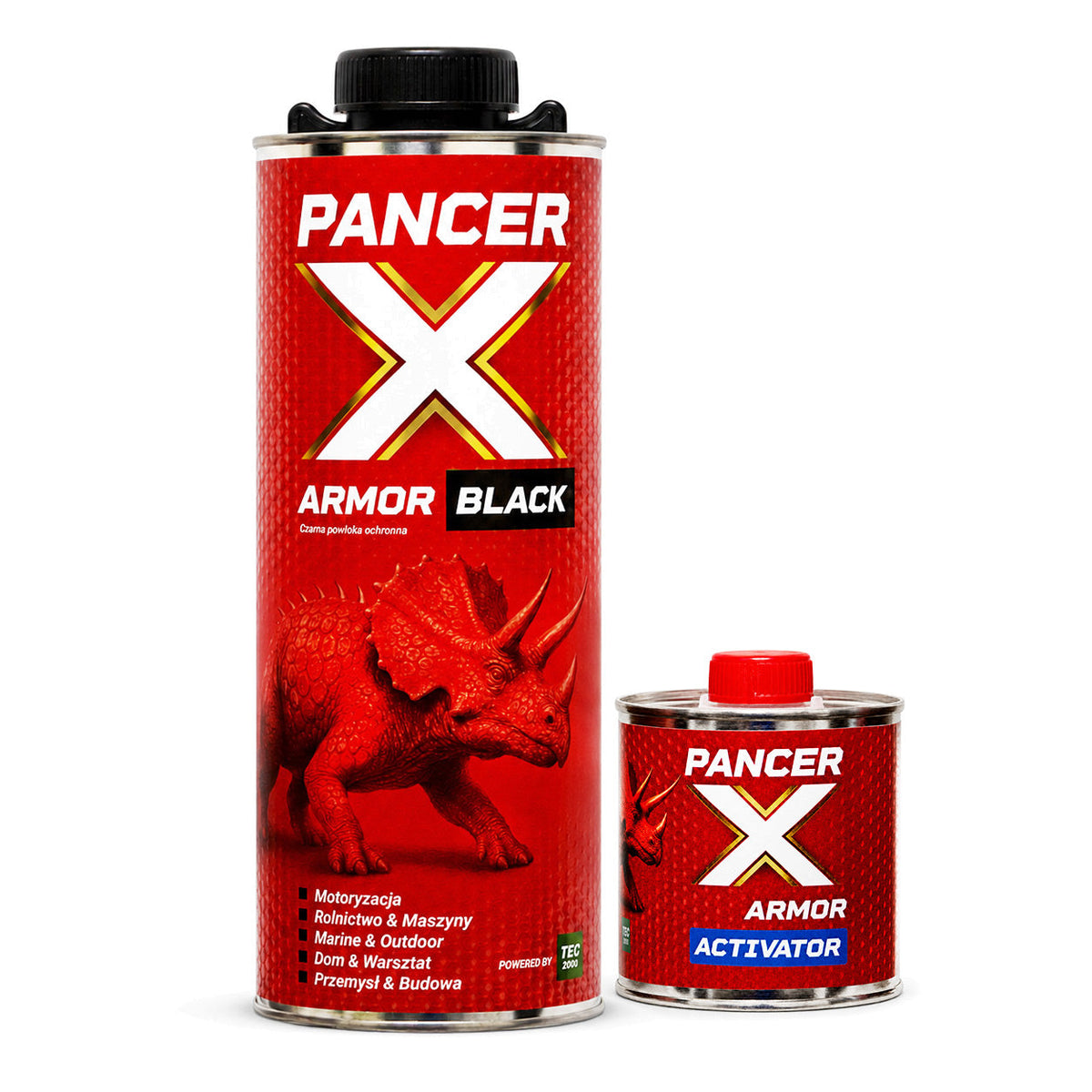
A kit of 600 ml base plus 200 ml activator gives 0.8 litres of mix. At medium texture that works out to roughly 3.6 m² per coat, at coarse texture, the one actually used on an underbody, roughly 1.6-2.0 m². That is a calculation, not a figure from the data sheet: the sheet gives coverage per litre and film thickness, and the conversion to a kit is ours. A compact car underbody with wheel arches is well beyond that, so count on several kits, not one. You apply 2-3 thin coats with a 30-60 minute gap between them. Once mixed with the activator, the material lives about an hour at 20 degrees, so mix in batches sized to what you can lay down.
Without a pit and without a lift
It can be done, but not the whole car at once. The realistic scope from axle stands is the wheel arches once the plastic liners are off, the sills from the outside and a strip along the floor edges. The middle of the floor from two stands is practically impossible to do properly: you cannot see where you are laying material, and that is the most common cause of missed spots. If the car already has corrosion sites on the floor, renting a bay with a lift for half a day costs less than redoing the job. Workshop labour runs PLN 150-250/h.
The order is always the same:
- wash,
- dry,
- remove the wheel arch liners,
- mechanically strip rust back to clean metal,
- degrease,
- abrade with P120-P180 paper on bare steel or P180-P240 on old coatings,
- only then the coating.
When taking the liners off, buy a full set of new expansion clips for your model straight away, because ten-year-old ones snap on removal and then there is nothing to fix the liner back with. The rust has to come off completely. Under a new layer it keeps working and after a year it pushes the layer off from below as a blister. That blister is exactly the failure mode covered in our guide to choosing rust paint, alongside surface bloom and an actual hole through the panel, so it is worth reading before you assume a fresh coat alone will fix metal that has already pitted.

What the service costs and how long it takes
Across 120 workshops in Poland the average price of underbody rustproofing comes out at PLN 1 517. The cheapest is PLN 1 200 in Kielce, the most expensive PLN 1 950 in Warsaw. The breakdown by package looks different and is more useful:
- passenger cars from PLN 500-700 for the basic job, PLN 800-1 000 for a mid scope and PLN 1 200-2 000 for the full one;
- SUVs PLN 1 000-4 000;
- vans PLN 2 000-3 000.
Duration: 4-6 hours for the basic job, 6-8 for a full passenger car, 8-10 for an SUV, 10-12 for a van. Workshops working with two-component coatings keep the car 2-4 days, and that is a good sign, because the coats have to flash off between each other.
The whole spread of prices comes from one thing: how much the workshop takes apart. Stripping wheel arch liners, shields and trims takes hours, not minutes, and that is what makes the difference between PLN 600 and PLN 1 800.
How to check whether the workshop did the work
Look inside a wheel arch. If the plastic liner has fresh product on its edges and the mounting screws are clean and untouched, the arch was never removed and someone sprayed blind. That is an acceptance criterion no workshop publishes, and it settles more than the look of the surface itself.
Second place to inspect: the manufacturing holes in the sills. There should be a run mark next to them or fresh plugs. Third: the jacking points and the edges along the floor, because missed spots show up there fastest.
Come back in spring and look
After winter, wash the underbody with water and no chemicals to get the salt off, and run your eyes over the same places: sill edges, jacking points, exhaust mounts, welds along the chassis rails. If the coating has chipped somewhere from a stone, touch it up. The same rule applies to a touch-up as to the whole job: abrade, degrease, only then material. Laying material over a dirty chip edge gives a patch that will come away in one piece along with the rest.
Full application parameters are collected on the technical data page, and answers to common questions in the FAQ. The product itself is here: ARMOR BLACK or the whole ARMOR collection.