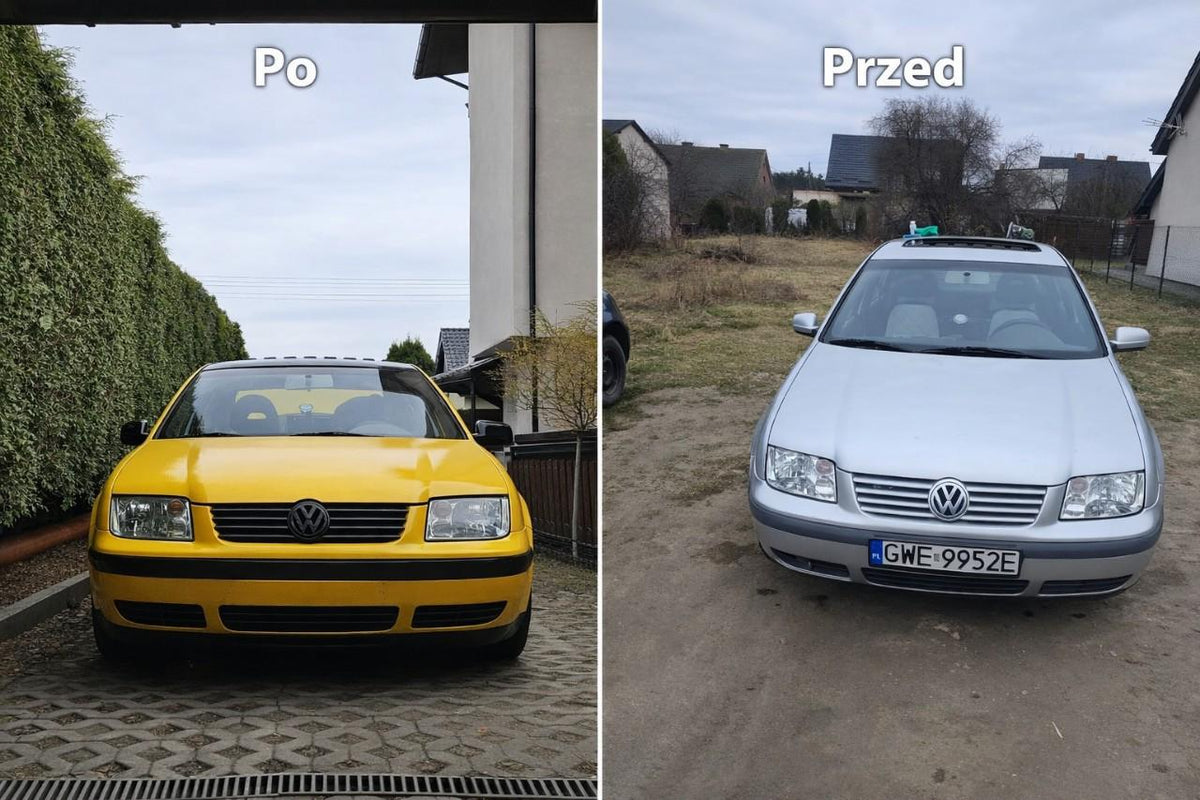
Every article about respray costs ends the same way: two ranges and no arithmetic. Body shop from eight to fourteen thousand, wrap from four to seven. Take your pick. These are Polish prices, collected from Polish body shops and detailing studios, and quoted in zloty.
There is a third route that nobody prices, because there is nobody to sell it to you as a service: you buy the material and do the work yourself. It does not suit every car and it does not work out for everyone, which I cover at the end, because there are situations where the body shop wins and the experiment is a waste of money. But to compare anything, you need a number. Below I have one.

Four prices in one table
Before I break this down, look at the scale. The gap between the options is not twenty percent one way or the other. One costs over ten thousand, another a few thousand, the third a few hundred zloty. The fourth row is PPF, which does not change the colour and lands in the table only because people put it next to a respray when they have the same budget.
| Route | Cost for a whole car | What you pay for |
|---|---|---|
| Body shop | PLN 8,000 - 14,000 | labour and material |
| Vinyl wrap | PLN 4,000 - 7,000, full spread of quotes 3,000 - 10,000 | labour and material |
| PPF on a whole car | PLN 17,718 on average | labour and material |
| 2K coating, done yourself | PLN 278 - 2,385 | material only |
The last row is not symmetrical with the first three, and I am saying so now so that nobody feels cheated later. There is no labour in it, because the labour is you.
The body shop: what PLN 8,000-14,000 buys
Let me start by defending that price, because under every comparison like this someone writes that body shops are expensive. For that money somebody strips the car down, works out the dents, fills, sands, lays primer, blocks it, sprays in a booth with filtered air, puts it all back together, and then gives you a warranty on it.
The spread in the price list comes from the size of the car and from how much work hides under the paint. Small compacts go for 5,000-7,000. Large saloons can reach 13,000-20,000. One workshop price list I found quotes 6,200-10,500 PLN for a B-segment car and prices a colour change separately at 7,800-9,500 PLN. That second number is the interesting one, because with a colour change the job does not stop at the outer panels: you have to go into the door shuts, the engine bay and the sills from underneath. Otherwise the old colour shows the moment you open a door and the whole car looks like a badly repaired write-off. The same trap comes back in every other option, just under a different name.
| Scope | Price |
|---|---|
| Small compact, same colour | PLN 5,000 - 7,000 |
| B-segment, full respray | PLN 6,200 - 10,500 |
| B-segment, colour change | PLN 7,800 - 9,500 |
| Average passenger car | PLN 8,000 - 14,000 |
| Large saloon | PLN 13,000 - 20,000 |
These prices make sense when the car is worth it. If the respray costs more than half the value of the car, the decision is about the car now.
Wrap: PLN 4,000-7,000 plus two bills nobody writes about
Wrapping a whole car in vinyl is most often PLN 4,000-7,000. The full spread of quotes runs from 3,000 to 10,000: cheap is a small hatchback in a plain colour, expensive is a big car with chrome trim and a specialty film.
Two items are missing from those figures.
The first is paint correction before application. Vinyl is transparent to whatever sits underneath it: every scratch and every speck of dust stuck to the paint will either telegraph through the surface or become the point where the film lifts. One of the more honest sources I found states it plainly in its price list: single-stage correction from PLN 800, multi-stage correction from PLN 2,000. On a car with mileage, applying film without that item makes no sense.
The second is removal. The argument that you can always peel the wrap off and get your original paint back appears in every article about wrapping, and in none of them does it come with a price. I do not have one either. I did not find a single price list in Poland that publishes a rate for stripping film off a whole car, so I am not going to invent a number. Just remember that this bill exists and it will arrive in five or seven years, when you sell the car.
PPF costs more than a full respray
This is the most surprising number in the whole comparison and I checked it twice. An aggregation of 120 quotes for PPF paint protection film on a whole car in Poland gives an average of PLN 17,718. Minimum 13,200, maximum 22,400.
So average PPF works out dearer than an average full respray, and it does not change the colour. PPF is a thick, self-healing polyurethane film meant to protect paint from stone chips. You are paying to protect what you already have underneath, and paying more than it would cost to lay new paint. That makes sense where the paint underneath is worth many times more than PLN 17,718. On a car worth a few tens of thousands there is no case for it at all.
PPF is not a single material but three layers laminated together: a top coat responsible for the self-healing and stain resistance, a TPU base layer, thermoplastic polyurethane, that absorbs the impact and makes up roughly 75-80 percent of total thickness, and an adhesive layer underneath that. Total thickness across the market runs about 6-10 mil, roughly 150-250 micrometres. Premium films usually sit nearer 7-8 mil, around 175-200 micrometres. The usual explanation for the self-healing: warmth, from the sun, a warm rinse, or a heat gun, in the rough range of 60-71 degrees C, lets the TPU chains in the top coat relax back toward their original shape. That smooths out light swirls and scratches. A stone chip that has cut all the way through does not come back that way. Warranty numbers vary by brand, but the pattern across installer sites is consistent: mid-range films are typically rated 5-7 years, premium films up to 10-12 years against yellowing, cracking and lifting, and real-world service life on a properly installed film tends to land around 7-10 years, which is the figure already in the table further down.
The third route: counting by the square metre
Here is the part you will not find in other comparisons, because it needs one number nobody quotes: how far the material goes.
Declared paint consumption in articles about doing it yourself varies by more than a factor of two. Some say a saloon takes a litre and a half, others say four. With a spread like that there is no calculation, because you can pick whichever result you want to see. The technical data sheet settles it.

Theoretical coverage for the ARMOR coating is about 4.5 m2 per litre at a dry film thickness of 100 micrometres. That figure depends on the texture you lay down, and that is a real variable, not marketing:
| Texture | Dry film thickness | Coverage |
|---|---|---|
| Coarse | 200-250 um | 2 - 2.5 m2/l |
| Medium | 100-120 um | 4.5 m2/l |
| Fine | 60-70 um | 6 m2/l |
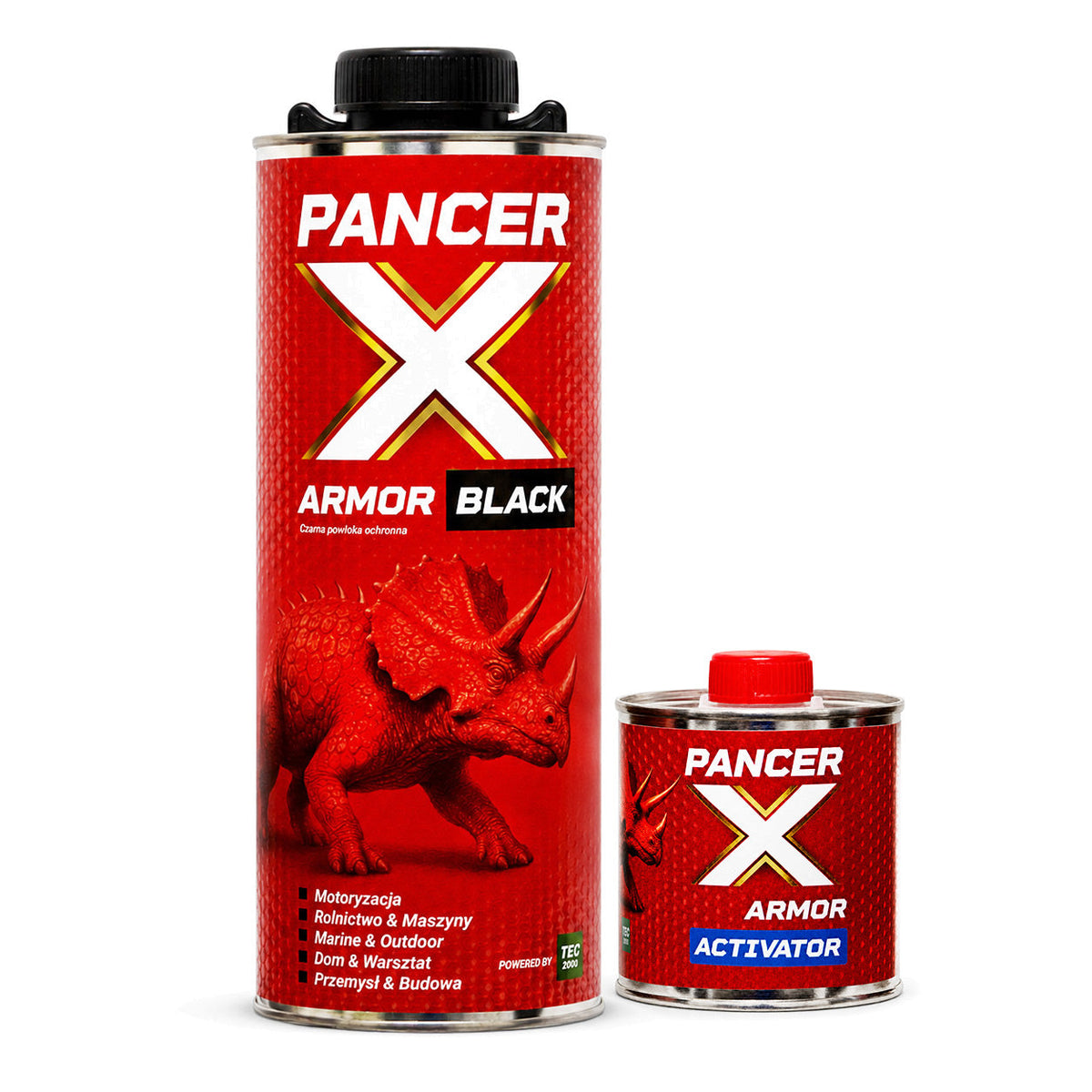
A kit is 600 ml of base plus 200 ml of activator, mixed 3:1. Once mixed you have 800 ml. The data sheet gives coverage per litre, not per kit, so I am doing that conversion myself and labelling it as mine: 0.8 litres times 4.5 m2/l gives 3.6 m2 for one coat at medium texture. You lay two or three coats, with a 30-60 minute gap between them.
An ARMOR BLACK kit costs PLN 139, ARMOR COLOR PLN 159. Divide the surface area of the car by 3.6, multiply by the number of coats, multiply by the price of a kit. So that you do not have to do that yourself for every car, we have a ready table.
How many kits your car takes
The table below is on the FAQ page and is given in 800 ml kits, which is what you actually buy. I have added the amounts at list prices. These are ranges, not a quote: how much you really get through depends on the texture you lay and on how many spots you end up redoing.
| Car | ARMOR BLACK | Cost | ARMOR COLOR | Cost |
|---|---|---|---|---|
| Small | 2-4 kits | PLN 278 - 556 | 4-6 kits | PLN 636 - 954 |
| Medium | 4-6 | PLN 556 - 834 | 6-9 | PLN 954 - 1,431 |
| Large | 6-8 | PLN 834 - 1,112 | 9-12 | PLN 1,431 - 1,908 |
| Van | 8-10 | PLN 1,112 - 1,390 | 12-15 | PLN 1,908 - 2,385 |
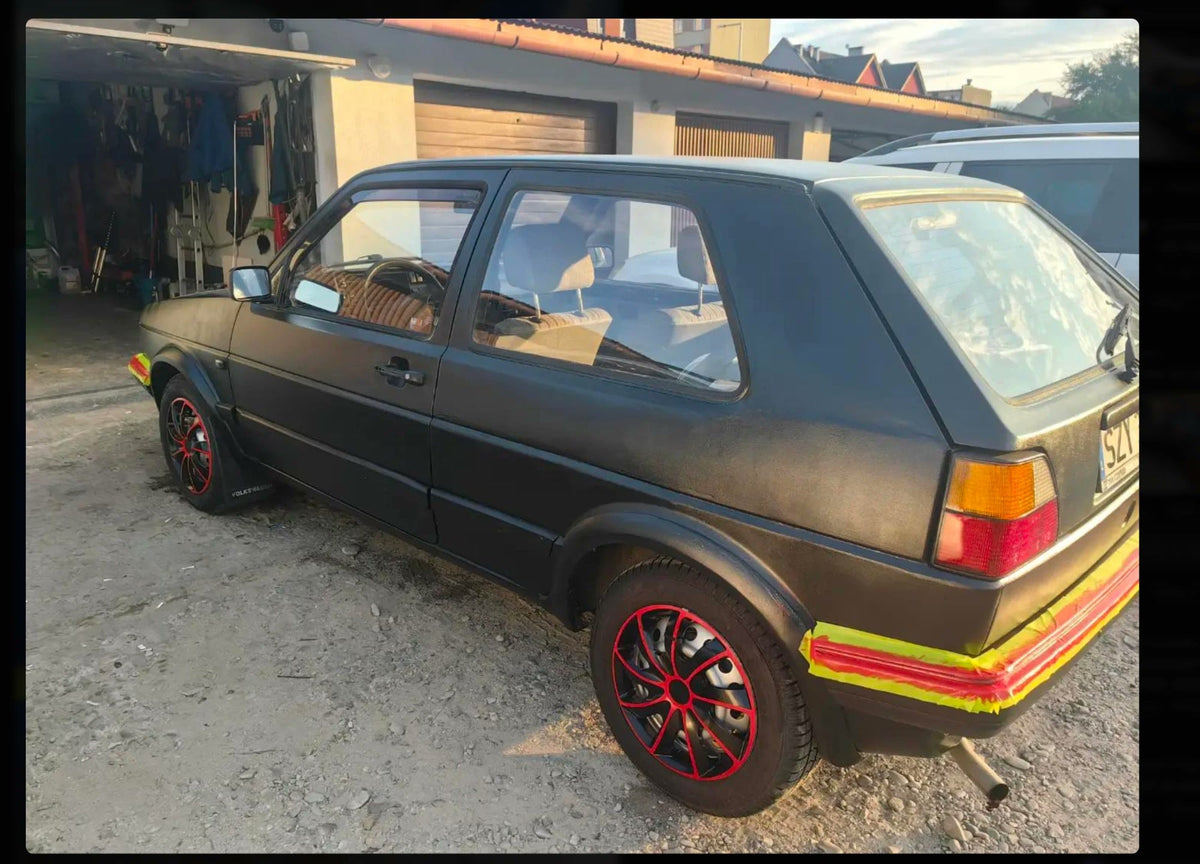
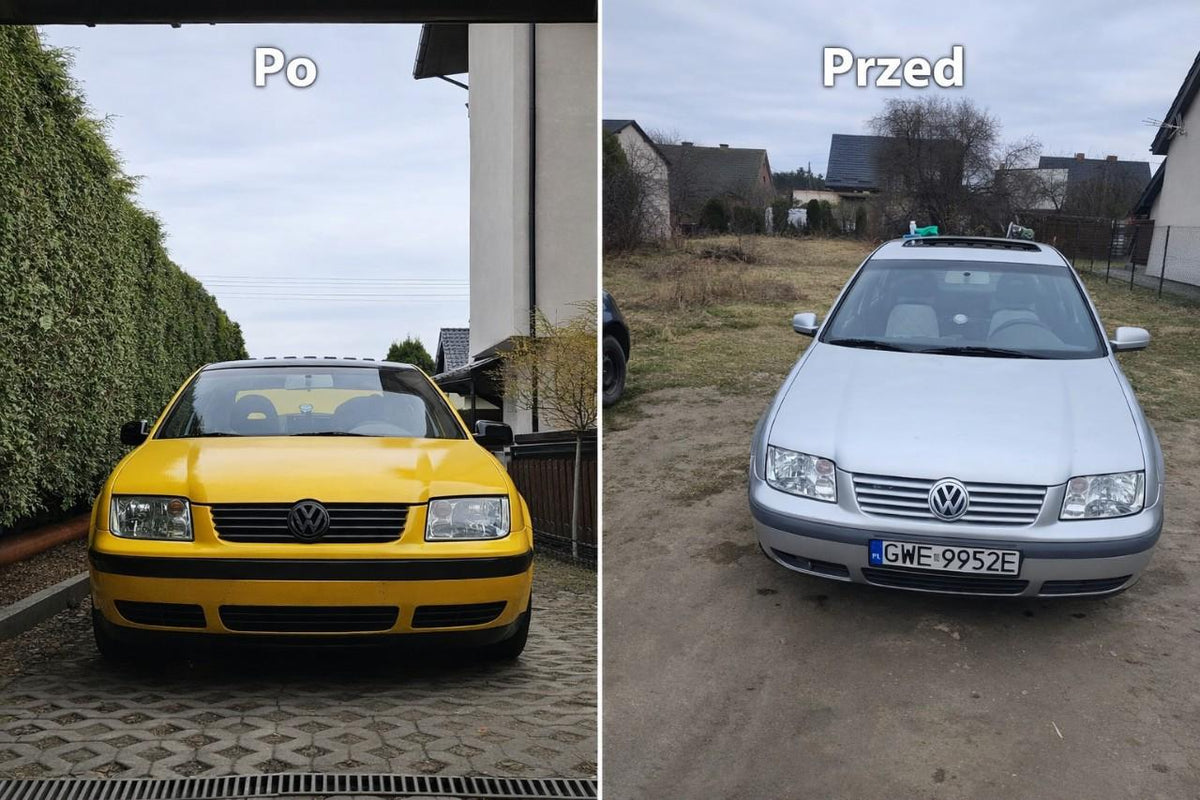
COLOR goes faster and that is how it should be. A light colour over a dark substrate needs more material to cover, and with yellow, red, orange and green you also need a white or light grey primer, otherwise the colour will come out patchy. The Bora in the photo above is exactly that case. While we are on pigment: you dose it into the base before the activator, 10-15 percent, and there is no point trying for more, because a higher dose may reduce the durability of the coating. The most expensive line in the table, a van in colour at PLN 2,385, sits below the cheapest wrap quote. If matte black specifically is the target, our dedicated matte black cost breakdown lines it up against wrap and paint for that one finish.

What this calculation leaves out
The number in the table is material for the coating and nothing else. To make the bill honest, the rest has to go in.
- Abrasive paper. Bare steel P120-P180, old coatings P180-P240, primer P240-P320. On a whole car that is not one sheet.
- Degreaser, masking tape, protective film for glass and seals.
- Thinner for acrylic products, also for cleaning the equipment afterwards.
- Personal protection. The base calls for a mask with a type A organic vapour filter, and the activator, when sprayed, an A2-P2 filter, because the aerosol contains isocyanates. Plus nitrile gloves and sealed goggles. A pharmacy face mask does not cover this.
- Somewhere to work. Substrate and ambient temperature from +10 to +30 degrees C, humidity below 80 percent, dry. In November in the yard you do not have that.
- Time. The mix has a pot life of about an hour at 20 degrees, so you mix in batches. Touch dry after 1-2 hours. The coating reaches full resistance after 5-7 days, and you plan everything it has to withstand around that date.
One thing people tend to discover halfway through the job: ARMOR does not go over single-component products. If the car was ever painted with 1K from a rattle can, that has to come off or be sanded back to primer, otherwise the solvent lifts the old layer and the whole weekend goes in the bin. The coating must also never be applied to the engine or the exhaust system.
Realistically these items add a few hundred zloty if you have nothing in the garage, and close to zero if you already have some of it. Even in the pessimistic version, the whole third route fits inside the range where a body shop is only just taking your deposit.
Ten years later
The purchase price is half the bill. The other half is the question of how many years it lasts, because a five-year product bought twice costs twice as much.
| Option | Declared service life |
|---|---|
| Calendered film (the cheaper kind) | 3-5 years |
| Wrap film | 5-7 years |
| PPF | 7-10 years |
| Factory paint, meaning the one from the production line | 15-20 years |
The last row is about factory paint and does not carry over to refinish work. How many years paint laid in a body shop lasts, I did not find in any price list, so I am not putting a number here. Film, on the other hand, can be counted. A wrap goes on twice in ten years, and before the first application there is paint correction from PLN 800 or from PLN 2,000. Two wraps at 4,000-7,000 plus one correction is PLN 8,800 - 16,000, and I am counting only that single correction there, while before the second wrap the paint underneath will most likely need one again. And at the end there is still the unknown cost of stripping the film off.
For the 2K coating I am not going to give a number of years, and I want that said plainly. The ARMOR data sheet does not declare durability in years, does not give hardness on any scale and does not give abrasion resistance in figures, so any such parameter would be one I made up. What the sheet does say: resistance to scratching, to UV, and to petrol, oils, water and salt, and that repairs are done locally, by keying the damaged spot and laying a fresh coat. Local repair of film does not exist, you replace the whole panel.
When each route makes sense
The body shop wins on a car worth more than a few tens of thousands that has to be sold with factory-quality paint, deep gloss on a flat surface. If you are selling the car within a year and the buyer turns up with a paint thickness gauge, do not get clever. No textured coating imitates paint.
Why a gauge and not a government printout: the official historiapojazdu.gov.pl service pulls together CEPiK vehicle records, the insurance guarantee fund, the technical inspection authority and inspection station data. It shows mileage from mandatory inspections, current OC insurance status, and the number and type of previous owners. Three keepers in two years is unusual. That kind of turnover usually means a fleet lease, an auction flip, or a car nobody wanted to keep for long. That's a different question, though. Paint history, in the description of what that service actually covers, is not a field that appears anywhere. Appraisers reach for a coating thickness gauge because there is nothing else to check. On factory paint, two Polish sources give different readings, 70-170 micrometres in one, around 120 in another, so treat either as a rough marker rather than a spec. One workshop's own numbers: a respray on a panel typically reads 200-250 micrometres, above roughly 300 it is read as scratches being masked, and around 1000 points to filler, meaning proper bodywork rather than a simple respray. None of that is an ISO standard. It is one shop's figures, written down, and it is still more than the state database offers.
You take the wrap when you want to change the colour for two or three years, the paint underneath is in good condition and it has to come back intact. Then even PLN 2,000 for correction is money well spent, because you are paying for reversibility.
PPF makes sense on paint worth many times more than the film itself. At an average bill of PLN 17,718 that is a very narrow set of cars.
A 2K coating applied yourself: a working car, an off-roader, a van, or simply something old that still runs. What you want is a surface that survives stones and washing, not a mirror. You accept texture instead of gloss. You have somewhere you can hold the temperature between +10 and +30 degrees C and humidity below 80 percent for a week, because the coating reaches full resistance after 5-7 days. The data sheet marks ARMOR as a product for professional use, and when choosing personal protection that has to be taken seriously rather than as label formality. There is also a case where this route is out despite the price: a car being prepared for sale through a dealer, where the smoothness of the paint is what counts. There, the few hundred zloty saved on material comes back off the transaction price.

Full application parameters, nozzles, pressures and drying times are on the technical data page. For the full sequence on one job, from bare panel to final coat, see our step-by-step roller application guide. Products: ARMOR BLACK at PLN 139 and ARMOR COLOR at PLN 159, the whole ARMOR collection here. If you do not know how many kits to order, the table in the FAQ is the same one as in this article, just without the amounts.