The question "what paint for rust on a car" assumes there is a tin somewhere that you simply open over a rusted sill. There is not. Rust is not dirt and not a stain, it is a layer of reaction product with a different volume than the metal below it, and it holds on to that metal poorly. Whatever you put on top, you are putting it on something that is already letting go.
What happens under a coating laid over a corrosion spot
Corrosion needs iron, oxygen and water. A thick coating cuts off oxygen from the outside, but water is already sitting in the porous scale and in the gap between the scale and the panel. It stays trapped there. The reaction continues, more slowly, in conditions where nobody can see it. In winter that water freezes and pushes the layer up from below. In spring you have a blister, and under the blister a worse state than before painting, because for a year the corrosion had constant access to moisture that rain would never have supplied.
Rust does not start evenly, and the reason is electrical as much as chemical. Tiny differences in the steel, a weld, a scratch, a spot under more stress, split the surface into anode and cathode. At the anode iron gives up electrons and dissolves as Fe2+, at the cathode oxygen picks those electrons up and becomes water. The overall reaction has a textbook driving force of about 1.68 volts, a number from a beaker at 25 degrees C that only matters here to confirm the reaction wants to happen. What links the two spots is the film of water sitting on the panel. It works as the electrolyte, the bridge that connects them electrically. Salt does not change that chemistry. It makes the water conduct better, so the same anode and cathode push more current through the same film and the metal loses faster. While we are on the subject of accidental wiring in metal: never bolt bare steel to bare aluminium without something in between, a rim, a bracket, anything, because two dissimilar metals in contact do the anode-cathode trick on their own. Salt also lowers the freezing point of that water film, so on a salted road in January the film often stays liquid and conductive through a cold night that would have frozen a plain rain puddle solid, and the reaction simply keeps running while you sleep.
Application over a damp or corroded substrate comes back as mistake number one in every workshop guide we read while writing this, and product descriptions in shops suggest the opposite. In a thread on the Nissan Klub Polska forum somebody put it more briefly than we did in two paragraphs: scale likes to crunch away underneath.
A thick, flexible layer has one more property that mechanics talk about with visible distaste. It masks. For five years you cannot see what is happening to the panel, because everything is evenly black, and then at an inspection it turns out the sill is soft over forty centimetres.
Three levels: surface bloom, blister, hole in the panel
Texts online treat rust as one phenomenon. These are three different jobs, with different costs and different endings.
Surface bloom is rusty dust on metal, with no change to the geometry of the surface. It comes off with paper or an abrasive pad in a quarter of an hour, and after that you really can move on. A blister is already a live spot: the paint is lifted, delaminated rust sits under it, and the loss reaches into the panel. Here paper is not enough, you have to go down with a disc or a wire brush to bright metal, edges included, because corrosion always runs further than you can see. The third level is a panel that is pierced, or thinned so far that it gives under finger pressure. At that point no chemistry has anything to do with it. That is cutting out and welding in a new piece.
Worth having the prices in mind before you decide what to do yourself. These are Polish rates, from Polish workshops. The cenauslug.pl service, which collected rates from 120 workshops, gives PLN 140-220 per hour for manual removal of corrosion spots, PLN 490-950 for removing corrosion from the bodyshell and PLN 1100-1650 for sandblasting the underbody. Sandblasting looks expensive until you count the hours with a wire brush.
A rust converter is not a shortcut
Products that convert iron oxides into stable compounds make sense where you physically cannot reach the metal: in recesses, on welds, in narrow gaps. They make no sense as a substitute for grinding on an open surface. They also demand patience. Workshop practice talks about 1-2 days of reaction before you put anything on top, and a reactive primer is a layer of at most 20 micrometres, which is to say nothing that protects on its own. Somebody who puts primer over a converter after an hour wastes both the converter and the primer.
Chemically, a converter does one of two things, often both in the same bottle. Tannic acid reacts with the iron oxides and turns them into ferric tannate, a blue-black compound that is far more stable than rust and does not want to keep reacting with water. Phosphoric acid takes a different route to a similar result, converting the oxide layer into ferric phosphate, a grey, largely inert film that passivates whatever it sits on. Both reactions need direct contact between the acid and the oxide, which is the whole reason the result is only ever as good as the surface it touched. On light, even surface rust with sound metal underneath, that is not a problem, the converter reaches everything. On a thick, blistered, multilayer scale it is. The converter reacts fast with the outer crust and then, more often than not, stops. Underneath, intact rust stays sealed under a layer that now looks converted and feels solid to the touch. Nothing about that chemistry puts metal back, either. A panel thinned to nothing, or one that flexes under a thumb, stays a welding job no matter how much converter you pour into it, and a converted surface still needs its own topcoat afterward, something built for the outside world like the ARMOR range.
Primer, and a two-pack one at that
Bare metal stays clean for a few hours, then it starts to bloom. So the next step is an epoxy or acrylic primer, laid on thick. A thin layer of epoxy does nothing, as auto-swiat.pl points out. And it has to be two-pack. A 1K primer out of a single tin, the twenty-zloty aerosol, cures by solvent evaporation, so every 2K layer laid over the top can dissolve it from below.
Where the role of ARMOR starts and where it ends
Surface preparation is described in grit grades:
- steel panel P120-P180,
- old coatings P180-P240,
- primer P240-P320,
- polyester fillers P240-P320 dry.
If you are not sure whether an old coating is fit to work over, wipe it with a cloth and thinner and see whether it comes off. That is five seconds that saves a whole Saturday.

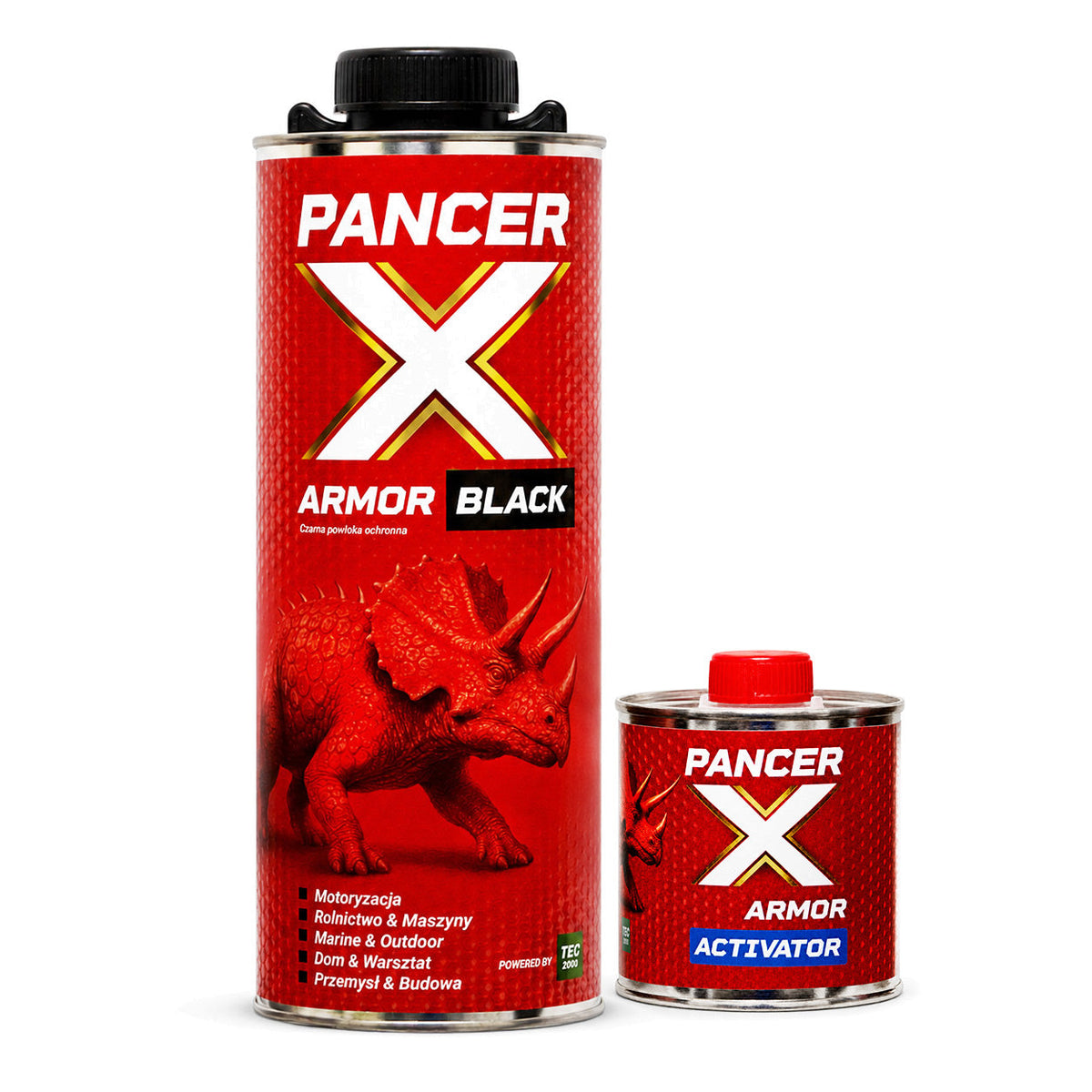
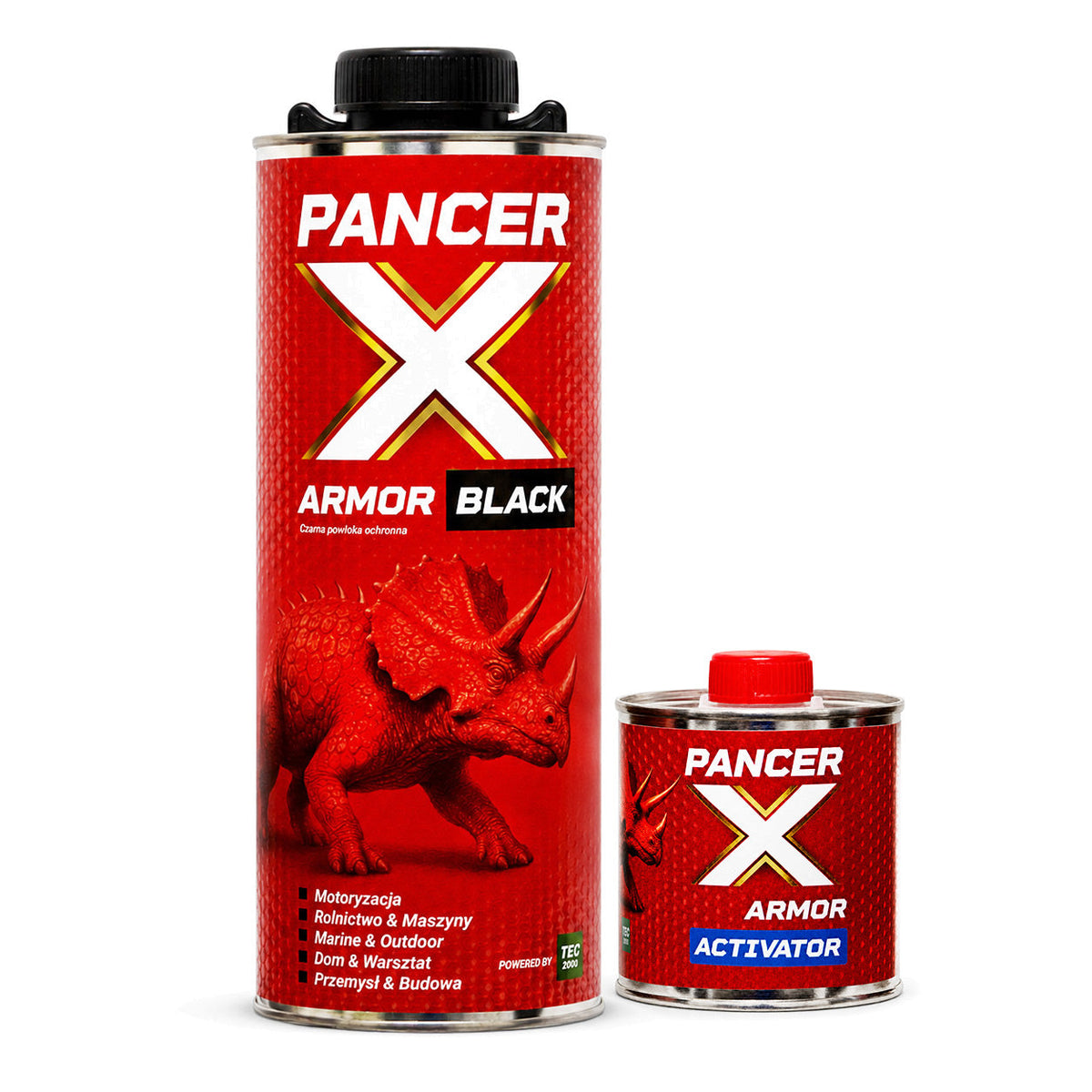
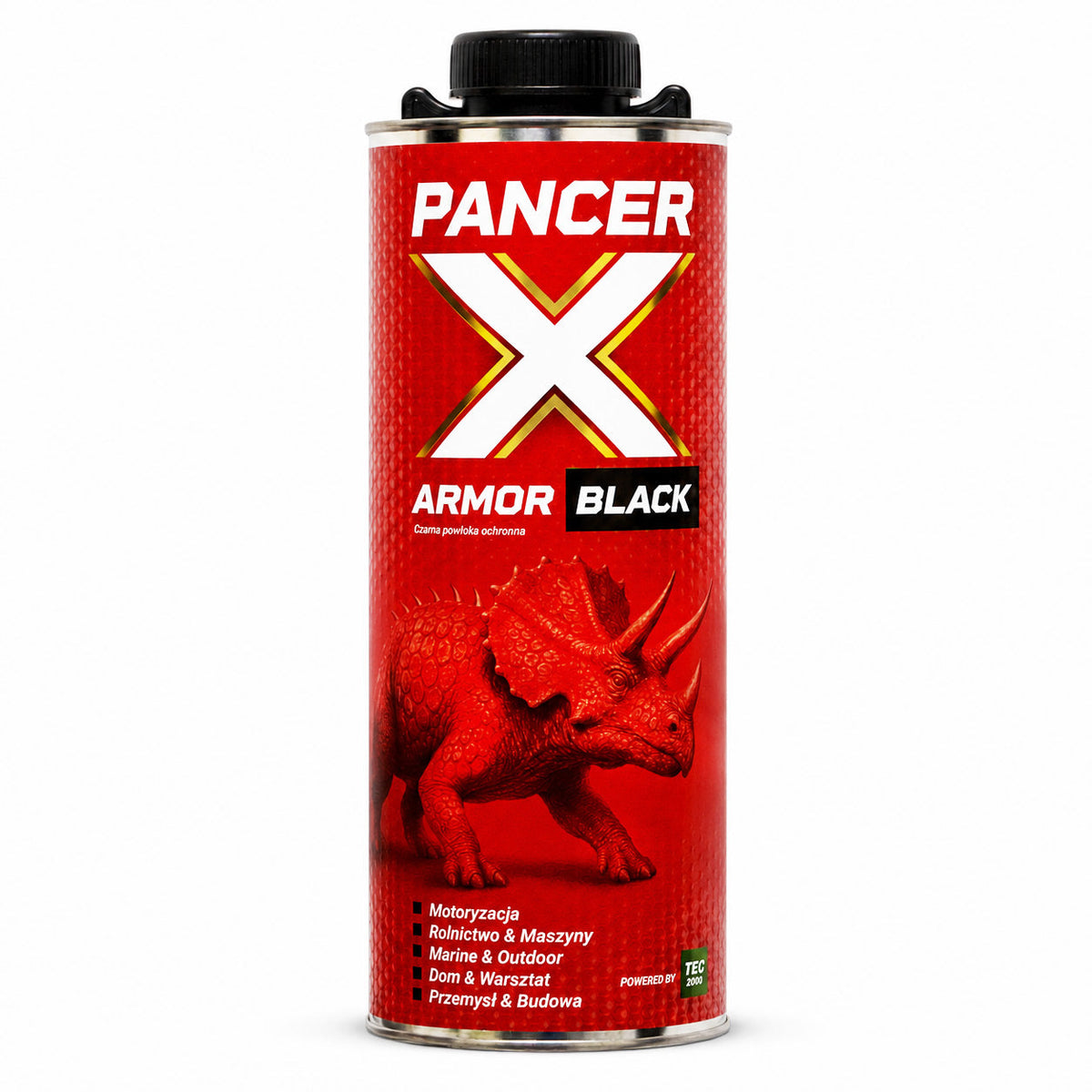
The application itself is short: 2-3 thin coats, 30-60 minutes between coats, touch dry after 1-2 hours, full resistance after 5-7 days. Do it with substrate and ambient temperature from +10 to +30 degrees C and humidity below 80 percent, because outside that range the data sheet answers for nothing. Mixed material has a pot life of about an hour at 20 degrees C, so mix as much as you can lay out. The coating contains no asphalt or bitumen, and it can be covered with acrylic paint if you want a colour to match the body. Paint goes on after a minimum of 3 hours, and if you give up on the weekend and come back to it a day later, the coating has to be flatted first, otherwise the paint has nothing to grip. The rest of the numbers are on the technical data page and in the FAQ, and the product variants are in the ARMOR collection.
Sills and closed sections are a different job
The most common corrosion spot in a Polish car sits where no coating will reach: inside the sill, in the chassis rail, in a pillar. You do not go into a closed section with a protective coating, you go in with a penetrating product, fed through a probe into the factory holes, one that creeps along the surface and displaces water. ARMOR will not get in there and is not going to pretend it will. The outside of the sill, the wheel arch, the boot floor, a pickup bed: yes. The inside of a section: no, and that is a job for a separate product, worth thinking about in the same week. See our underbody rustproofing guide if you want the specific product for that job.